Hemispheres & Re/Presentation
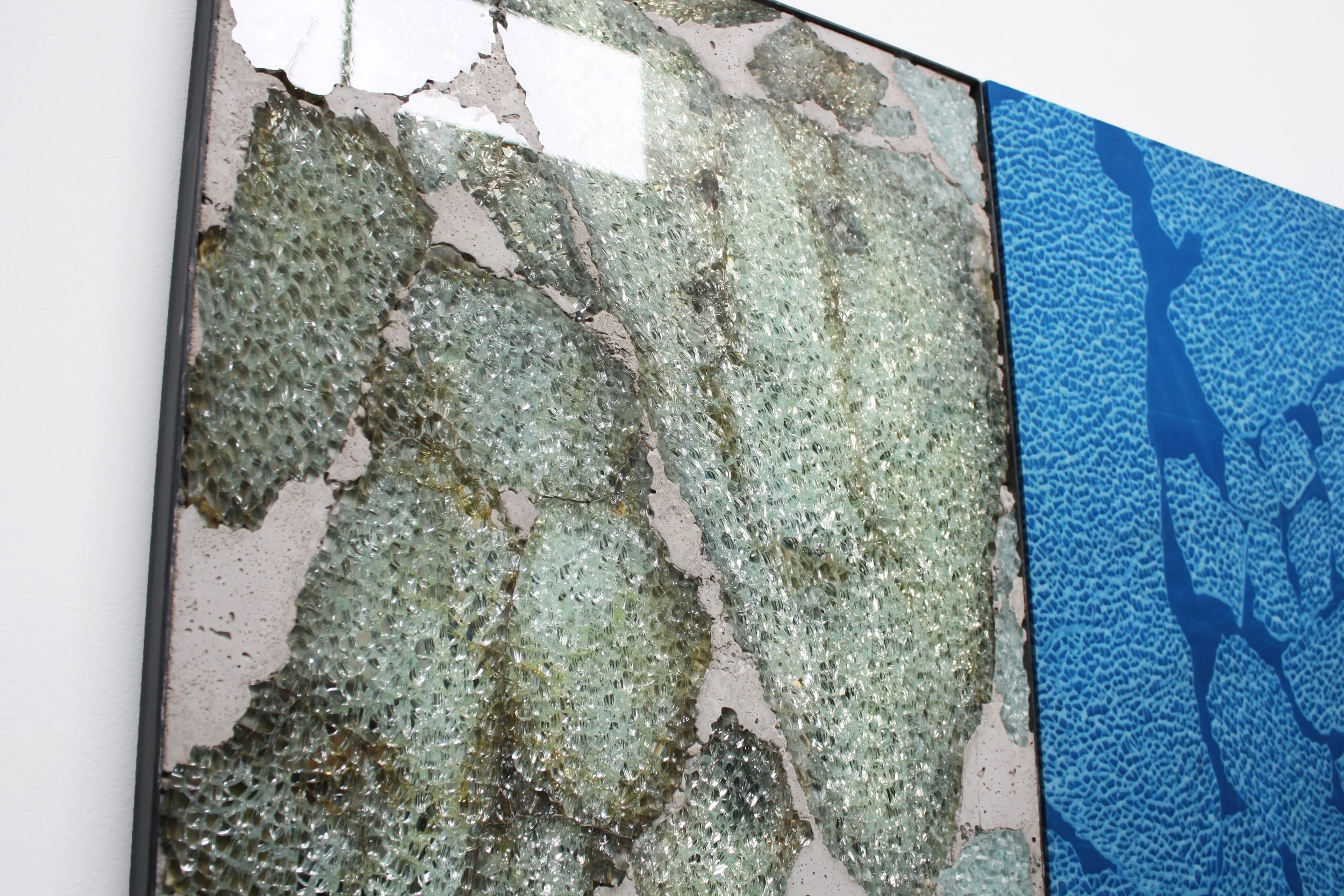
Re/Presentation, detail.
In my daily rhythms of the studio, home, and public life, I feel a constant tension between the technocratic panopticon and my tangible presence. Two realities—the physical and the virtual—are vying for my attention. Our constant connectivity holds a promise of efficiency and productivity, but I am fragmented when every person and platform has perpetual access to me. This tension fuels my conviction to ground reality in the material world; to gain literacy in the mechanisms that translate images and information through a digitally mediated interface.
In his book “The Master and His Emissary,” Iain McGilchrist provides a neuroscience framework for thinking about this tension. He researches the left and right hemispheres of the brain, arguing that these asymmetrical sides present two different realities. While the left side sees small parts of the whole that it can consume or control, the right side sees the whole complexity, motion, and entanglement of all things. From the ancient world to the enlightenment, industrial revolution, modern and post-modern eras, humanity has been on a trajectory that has increasingly valued the functions of the left hemisphere over the right, the quantitative over the qualitative, and that of isolated rationality over a larger contextualized sense of reason. Left brain processing thrives within technocratic imperatives, which—in all their complexity—are flattening our perception of people, place, and things. Because the left hemisphere doesn’t see depth in space, time or emotion, we are in the shallows as a society, and our faculties of perception are in need of repair.
Beginning with Cartesian thinking in the 17th century and gaining traction during The Enlightenment, societies began to uphold representation over what is present to sensory experience. The very word “represent”, when broken down, is to present something again, in such a way that is removed from its essence or origin. That removal or filtration from the essence simplifies, flattens, and makes the original entity digestible. Flatness is a useful shorthand, and tempting to center as our reality because those sounds bites and abstractions are easier to quantify and control. G. K. Chesterton writes, “The poet only asks to get his head into the heavens. It is the logician who seeks to get the heavens into his head. And it is his head that splits (1908).” Simply put, there are some aspects of existence that you won’t be able to quantify or explain empirically, but you can experience it. Qualitative and sensorial knowledge make room for us to peak into the heavens and take a look around.
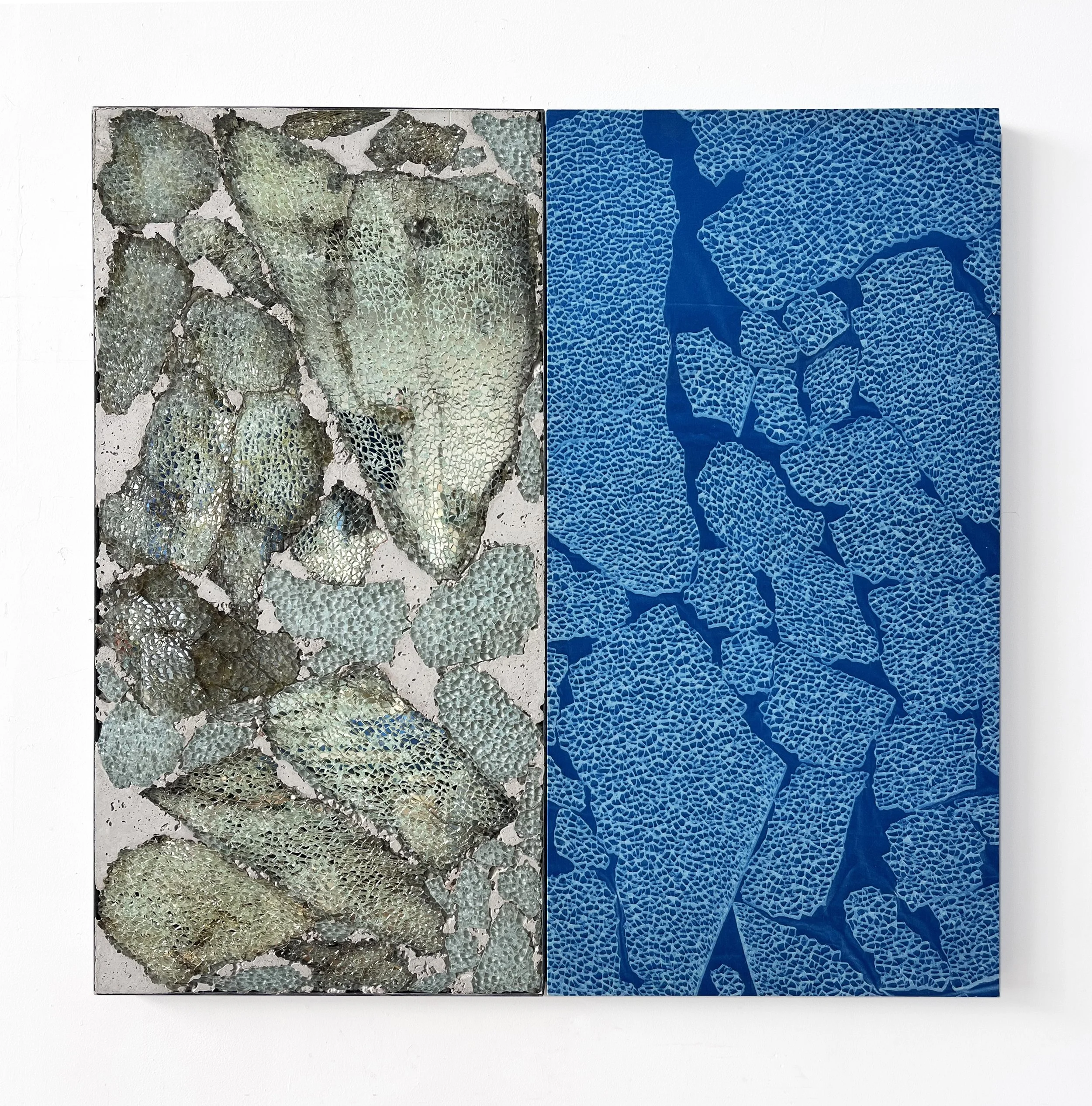
Re/Presentation, glass, silver, concrete, steel, cyanotype on cotton, 36” x 36”, 2025
My aim is to reorder the hierarchy of qualitative sensory experience over comprehension of a quantifiable and dissected set of entities; Not for the sake of some vague soup of feelings, rather to allow our faculties of perception to take in the whole, engaging a larger sense of reason that includes both sensorial and empirical legibility. For example, in Re/Presenting I, I have hung two panels side by side that point to vastly different material ecologies. Like the brain’s hemispheres, they are twins in origin, but represent different realities: the real and the represented, the complex object and the flat image. On the left panel, the material itself is the content of the work. As an object, it functions as both signifier and signified—identifiable as glass, steel, concrete—while also pointing to the geologic, architectural and psychological worlds.
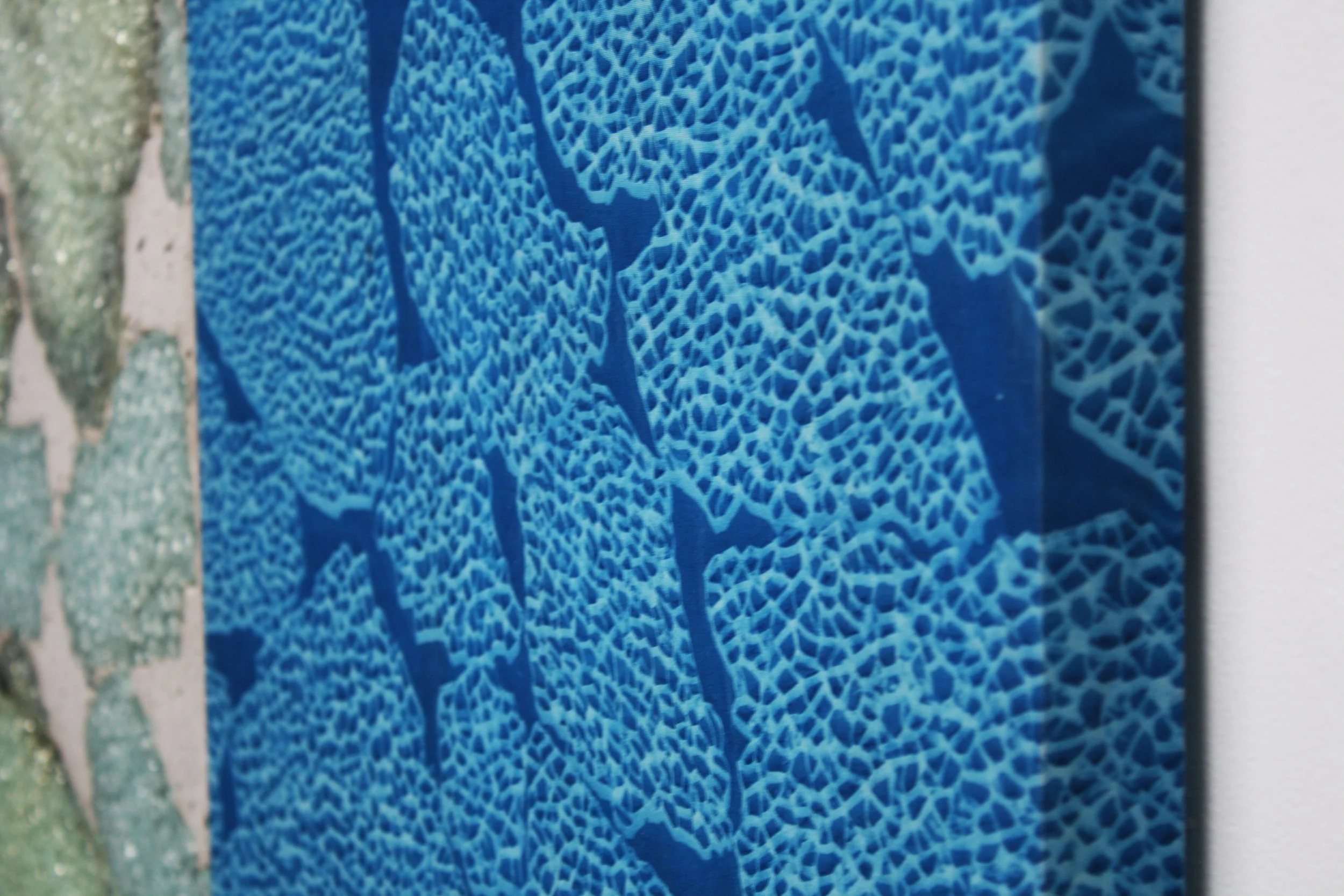
On the right is a cyanotype of similarly sized tempered glass chunks. Pristine and monochrome, it poses more as an image, a flattened residue of the object it represents, dislocated from the materiality of the glass. The blue of the cyanotype tips the imagery towards the glacial, alluding to aerial photography of The Arctic Sea. Printed on cotton and stretched over a frame of the same dimensions, it functions as its counterpart. Like the dissected entities of the left hemisphere, it is graphic and digestible. Revealing the anatomy of this vitreous material, it shows how light travels through the glass during the cyanotype exposure: an important view, but not the whole.
Side by side, these halves become whole. The pristine blue cyanotype gives a sense of weight to the concrete. Conversely, the heavy gritty concrete enhances the light cleanliness of the fiber. A viewer might be lured into the work by an emotive response, but with a little time spent, these echoes of architecture, geologic and glacial forms, material vitality, and implication of the self all begin to seep out in this space between image and object, between signifier and signified, between left and right hemisphere. This space—which does not point singularly to any one thing—allows one to grapple with the depth, complexity, and mystery of material ecology. When drawing conclusions with a particular, fractal, and expansive set of clues, our sense of reason can imagine a world much bigger than empirical legibility will allow.
Bibliography
Chesterton, G. K. Orthodoxy. John Lane, 1908.
McGilchrist, Iain. The Master and His Emissary: The Divided Brain and the Making of the Western World. Yale University Press, 2019.